The Leadership Decay Curve: The First Signs That New Behaviors Are Starting to Fade
A common situation unfolds in many organizations.
A few weeks after a training, a program, or a leadership development initiative, it becomes hard to know what has actually changed.
The participants enjoyed the experience. Ideas were understood. Intentions probably still exist.
But the behaviors? That's often less clear.
The thing is, new behaviors rarely disappear overnight. They fade gradually. And well before a dashboard or annual survey can detect it, certain signals begin to appear.
At IgniteUp, this phenomenon is called Leadership Decay.
Leadership Decay Rarely Starts with a Disappearance
When we think about a behavior disappearing, we often imagine something abrupt — as if a manager suddenly stopped practicing what they'd learned.
In reality, it rarely works that way.
Feedback doesn't vanish entirely. It simply becomes less frequent. 1:1s aren't dropped. They're pushed back more often. Recognition doesn't stop. It becomes more occasional.
That's precisely what makes the phenomenon hard to identify. The change still exists. But it gradually loses regularity.
And that loss of regularity is often the first sign of Leadership Decay.
Signal #1: Feedback Becomes Less Frequent
One of the first behaviors to erode is often feedback. Not because it's seen as useless. But because it requires attention. Preparation. Sometimes courage.
Early on, more conversations happen. Then they become more spaced out. Opportunities get pushed back. Priorities shift.
Feedback is still there. But it gradually stops being a regular practice.
Signal #2: 1:1s Become Easier to Reschedule
1:1s are often among the first casualties of a packed calendar.
One meeting gets moved. Then another. Then a third. None of these decisions seems dramatic on its own.
Yet their accumulation often sends an important signal. When newly acquired behaviors start losing their place on the calendar, Leadership Decay is often already underway.
Signal #3: Recognition Becomes Exceptional Again
In many teams, recognition is rarely absent. The real issue is its frequency.
After a moment of awareness or training, managers often express more recognition. Then the pace slows. Good intentions remain. But behaviors become more occasional.
Again, the change doesn't disappear. It just becomes less visible.
Signal #4: Open Questions Disappear
A leadership shift is often perceptible in how conversations evolve.
Early on, a manager may ask more questions. Explore more. Seek to understand. Then, gradually, old reflexes return. Answers replace questions. Advice replaces exploration. Exchanges become more directive again.
This gradual return to prior habits is often another signal of Leadership Decay.
Signal #5: Conversations Become Transactional Again
One of the subtler changes concerns the quality of interactions.
At first, more space is created for listening. For coaching. For deeper conversations. Then exchanges gradually refocus on tasks. Topics get covered. Decisions get made. Work moves forward.
But something has shifted. The relational dimension has lost ground. And that evolution often goes unnoticed until its effects show up somewhere else.
Why These Signals Matter
Leadership Decay doesn't typically start when behaviors disappear. It starts when they become less frequent.
That distinction matters. It explains why so many organizations feel like everything is fine, when certain behaviors are already eroding.
Traditional indicators often detect the consequences. Observable behaviors let you detect the early signs — much earlier.
What Teams Notice Before the Indicators Do
Teams observe behaviors every day. They notice shifts in tone. Habits that appear. Habits that fade. Conversations that become richer. Or rarer.
That's why the first change signals are often visible well before measured results show up. And it's also why observable behaviors are such valuable indicators — they let you see leadership evolving while it's happening.
The Leadership Decay Continuum™
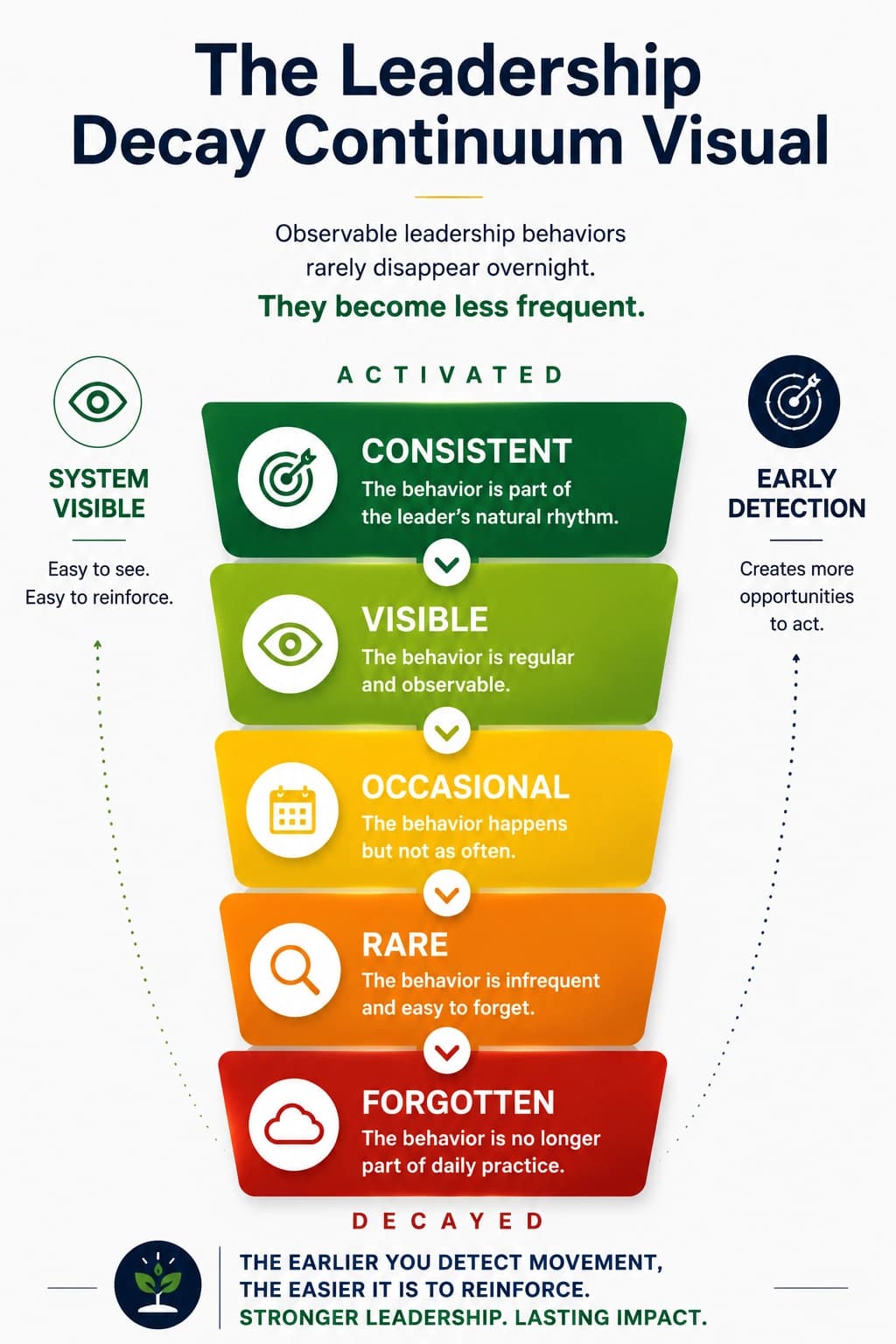
At IgniteUp, Leadership Decay isn't considered an event. It's a continuum.
Behaviors typically evolve along an observable progression. They rarely go from present to absent. They first become less regular. Then less visible. Then rarer. Then gradually forgotten.
That distinction matters. Because it allows you to detect the first signs of erosion long before behaviors disappear entirely.
What to Take Away
Leadership Decay typically doesn't start when behaviors disappear. It starts when they become less frequent. Less visible. Less regular.
The real risk isn't that behaviors will vanish. The real risk is not noticing that they've already begun to slide along the Leadership Decay Continuum™.
And the earlier that movement is detected, the easier it becomes to act before behaviors fade entirely.
Ready to see behavior change in your organization?
IgniteUp structures leadership activation week by week — with the indicators to prove it's working.
See How IgniteUp Tracks Behavior Change